Small Talk Made Simple: Printable Prompts for Confidence

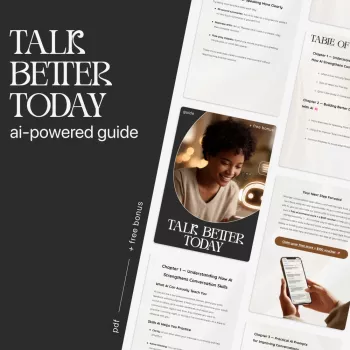
Small Talk Made Simple: A Printable Guide for Better Conversations and Everyday Confidence
Small talk is a practical skill, not a personality trait. With a few repeatable frameworks—what to say, how to listen, and how to exit—everyday conversations can feel lighter, clearer, and more natural. This digital download printable eBook is designed to be used in real moments: at work, in stores, at events, on dates, and anywhere a quick connection matters.
What “small talk” is really for
Small talk isn’t about being “good with people” 24/7. It’s a social on-ramp: a low-pressure way to move from strangers to familiarity before deeper topics make sense.
- Builds a low-pressure bridge from strangers to familiarity before deeper topics
- Signals friendliness and reduces uncertainty in new or awkward situations
- Helps discover shared context (place, purpose, people, timing) quickly
- Creates momentum: once a comfortable rhythm is established, deeper conversation becomes easier
- Supports everyday goals: networking, teamwork, customer service, dating, and community connection
Communication research consistently points to the value of listening, clarity, and emotional safety in relationships and work. For a deeper overview, see the American Psychological Association’s page on communication and relationships, and workplace-focused guidance on Harvard Business Review.
What’s inside the Small Talk Made Simple digital download
The Small Talk Made Simple printable digital download is built for real-life use: quick prompts, clean conversation “loops,” and short scripts that still sound like you.
- Printable prompts and conversation starters for common settings (work, parties, waiting rooms, errands)
- Simple question patterns that keep conversations flowing without sounding scripted
- Listening and follow-up cues to turn a short exchange into a comfortable back-and-forth
- Quick reset tools for nerves, blank-mind moments, and awkward silences
- Easy “graceful exit” lines to leave the conversation on a positive note
Quick overview: when to use each tool
| Situation | What to say | Best follow-up |
|---|---|---|
| Meeting someone new | “How do you know the host/team?” | “What’s been the highlight of your week?” |
| Workday small talk | “How’s your day going so far?” | “Anything you’re looking forward to after work?” |
| In line / waiting | “This line is moving faster than I expected.” | “Have you been here before?” |
| After a shared activity | “What did you think of that?” | “What part stood out to you most?” |
| Awkward pause | “I’m curious—how did you get into that?” | “What do you enjoy most about it?” |
| Leaving politely | “I’m going to say hi to a few people—good talking with you.” | “Hope you enjoy the rest of the event.” |
A simple conversation flow that works almost anywhere
When small talk feels hard, it’s usually because the brain is trying to invent the “perfect” thing to say. A simple flow removes that pressure. Think of it like five stepping stones:
- Start with context: comment on the shared situation (location, event, time of day) to feel natural
- Ask one open question: choose “what” or “how” questions that invite a short story rather than a yes/no
- Reflect and extend: mirror a key word back (“Oh, hiking—where do you like to go?”) to encourage detail
- Offer a small share: add one related sentence about yourself to balance the exchange
- Close cleanly: end while it’s still positive using a friendly, brief exit line
This structure helps you avoid two common extremes: interrogating someone with rapid-fire questions, or feeling like you have to carry the whole conversation alone.
Easy social skills that make small talk feel effortless
“Effortless” rarely means “talk nonstop.” It usually means you look comfortable: relaxed, present, and clear.
- Use warm minimalism: smile, relaxed posture, and one clear sentence—no need to perform
- Aim for two beats: a question plus a follow-up is often enough for a good micro-conversation
- Prefer specifics over big topics: “What have you been watching lately?” beats “What do you do for fun?”
- Name-friendly technique: repeat the person’s name once early, then once near the end
- Keep attention outward: notice details (a book, a badge, a venue) to reduce self-consciousness
- Avoid conversational traps: rapid-fire questions, over-apologizing, or jumping to advice too quickly
If nerves show up, don’t fight them—reduce them. A quick pre-conversation reset can help; the Mayo Clinic’s overview of stress management basics offers simple techniques you can borrow before events, meetings, or first dates.
Everyday scripts (that don’t sound like scripts)
The best “scripts” are really patterns: a starter that fits the setting, then one follow-up that shows you’re listening.
Handling common pain points: awkwardness, anxiety, and silence
Making the printable eBook part of daily life
For an extra boost to daily energy and focus (which often affects social ease), pair your routine with better rest habits. The AI-powered checklist for better sleep adventures is a simple digital companion for winding down and building a calmer baseline.
Digital download details and who it’s best for
FAQ
How fast can small talk skills improve with practice?
Noticeable improvement can happen within a week or two when you repeat a small set of openers and follow-ups in low-stakes moments (cashier lines, elevators, quick check-ins). Progress is best measured by comfort and consistency, not perfectly “smooth” conversations.
What if the conversation feels one-sided?
Switch to easier questions, reflect a key word they used, and offer one small share about yourself to rebalance the exchange. If it stays low-engagement, use a polite exit and move on without taking it personally.
Is the guide suitable for introverts or people with social anxiety?
Yes—it’s built around low-pressure prompts and short conversation loops, so you can practice without forcing long interactions. Start in calmer settings, keep conversations brief, and build up gradually as your nervous system learns “this is safe.”








Leave a comment