AI Home Workout Plan: Adaptive Weekly Routine & Checklist
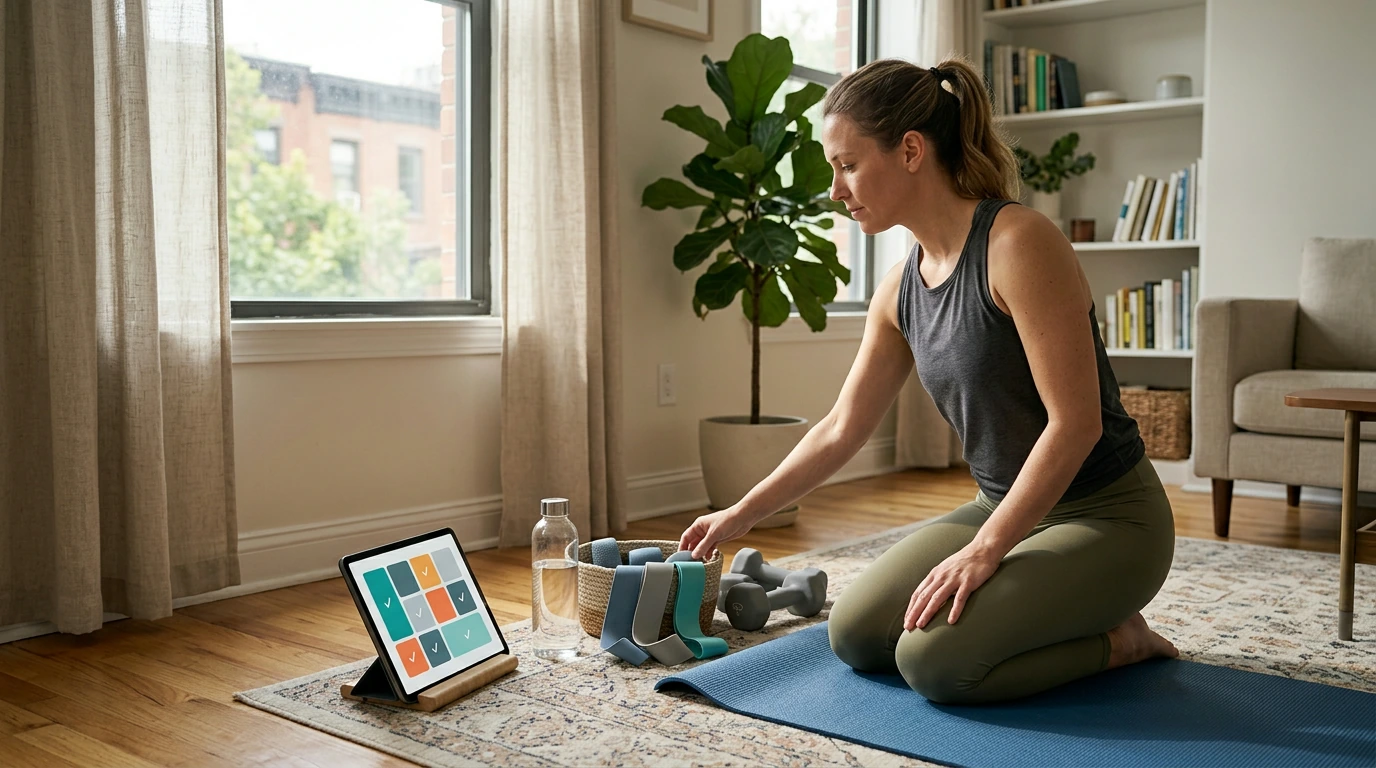
Build a Home Workout Plan That Adapts to You With AI
A home routine works best when it matches your goals, schedule, equipment, and how your body feels week to week. AI can help generate fresh exercise ideas and organize them into a practical plan, but results improve dramatically when your inputs, constraints, and safety rules are clear. Below is a simple way to get tailored workout ideas, turn them into a repeatable weekly structure, and use a checklist to stay consistent. For more guidance, see How to Use AI to Plan Your Next Workout.
Who this approach fits best
- Beginners who want straightforward options without guessing what to do next
- Busy schedules that require short sessions (10–30 minutes) and flexible days
- Home setups with limited equipment (bodyweight, bands, a pair of dumbbells)
- People who get bored repeating the same routine and want variety with structure
- Anyone returning after time off who needs a gradual ramp-up plan
If your routine often stalls because you’re juggling time, energy, or minor aches, an adaptive plan is especially useful. It helps you keep the “shape” of the week consistent while swapping the exact exercises or intensity based on readiness. For further reading, see Create Custom Workouts Using ChatGPT.
The inputs that create truly personalized exercise ideas
Better inputs lead to better sessions. Aim to pick 1–2 priorities and be honest about constraints. If you’re returning after time off, include what you did recently (even if it was “mostly walking”).
- Goal: strength, fat loss, mobility, cardio capacity, posture, or a mix (pick 1–2 priorities)
- Experience level: new, intermediate, advanced; include recent activity history if returning
- Schedule constraints: days per week, session length, preferred training times
- Available equipment and space: list what is on hand and what is off-limits
- Movement limitations: past injuries, joint sensitivities, medical restrictions; note what aggravates symptoms
- Preferences: exercises you like/dislike, music/noise limits, impact level, indoor/outdoor
- Progression rules: add reps, add sets, slow tempo, or add load; define how often to progress
| Input | Examples | Why it matters |
|---|---|---|
| Goal | Build full-body strength; improve core stability | Determines exercise selection and weekly balance |
| Time | 3 days/week; 25 minutes/session | Sets realistic volume and recovery needs |
| Equipment | Bodyweight + resistance band | Prevents unusable recommendations |
| Limits | Knee pain with deep squats; avoid jumping | Keeps training safe and sustainable |
| Preferences | Likes circuits; dislikes long runs | Improves adherence and enjoyment |
| Progression | Increase reps weekly until top range, then add band tension | Creates measurable improvement |
For a ready-to-use set of templates and an organized way to capture these inputs, see the Using AI Prompts to Generate Personalized Exercise Ideas – Home Fitness eBook, Workout Guide, AI Workout Checklist.
A simple workflow that turns ideas into a complete plan
1) Build an “exercise menu” by movement pattern
Organize options into squat, hinge, push, pull, carry, and core. This keeps variety from becoming random and makes substitutions straightforward.
2) Get three levels for each move
Ask for easy/standard/challenging versions. That way, a low-energy day doesn’t become a missed workout—it becomes a lower gear.
3) Build sessions with time blocks
Instead of a long checklist of exercises, use: warm-up (3–5 minutes), main work (12–20), finisher (2–6), cool-down (2–5). This keeps sessions realistic when time is tight.
4) Match reps and rest to the goal
Strength tends to benefit from moderate reps and longer rests; conditioning from shorter rests and steady pacing; mobility from controlled tempo and longer holds. For baseline activity targets, the CDC adult physical activity guidelines are a helpful reference point.
5) Add progression and occasional deloads
6) Create an if-then substitution list
Weekly structure that balances results and recovery
| Day | Focus | Main exercises (examples) | Notes |
|---|---|---|---|
| Mon | Full-body strength | Squat pattern + push + pull + core | Moderate reps; longer rests |
| Tue | Cardio + mobility | Brisk walk or bike + hips/shoulders mobility | Keep intensity easy |
| Thu | Full-body conditioning | Circuit: hinge + push + pull + carry | Short rests; steady pace |
| Sat | Lower + core emphasis | Hinge pattern + lunge + glutes + anti-rotation core | Add a finisher if time allows |
Technique first: controlled tempo and a comfortable range of motion beat rushing reps. For resistance training fundamentals and safe progressions, the ACSM resistance training guidance is a solid overview.
Safety rules to build into every generated routine
The workout checklist that keeps plans consistent
If you want a printable/digital structure to keep this simple, the Home Fitness eBook and Workout Checklist can help you log sessions and plan substitutions without rebuilding your routine each week.
What to expect in the first month
A practical digital guide for building tailored home workouts
Two small additions that support consistency: wearing breathable training gear so sessions feel less “fussy” (see the Men’s Quick-Dry Short Sleeve Sports Shirt), and improving sleep routines so recovery keeps pace with training (the AI-Powered Checklist for Better Sleep Adventures can help you build a repeatable wind-down plan).
FAQ
Is it safe to rely on AI for workout ideas?
AI can generate useful options, but safety depends on accurate limitations, conservative progression, and prioritizing technique. If you have medical conditions, are post-surgery, or have recurring pain, consult a qualified professional before increasing training intensity.
What information should be included to get workouts that match a home setup?
Include your goal, days per week, minutes per session, available equipment/space, impact tolerance, injuries or limitations, exercise preferences, and a simple progression rule. Ask for balanced movement patterns (squat/hinge/push/pull/carry/core) so the plan stays well-rounded.
How can workouts stay varied without becoming random?
Keep a consistent weekly structure and rotate variations within the same movement patterns (for example, swap goblet squats for split squats). Track one or two progression metrics so variety still builds toward measurable improvement.









Leave a comment