Move First, Think Forward: Printable Proactive Mindset Guide

Move First, Think Forward: A Printable Guide to Building a Proactive Mindset
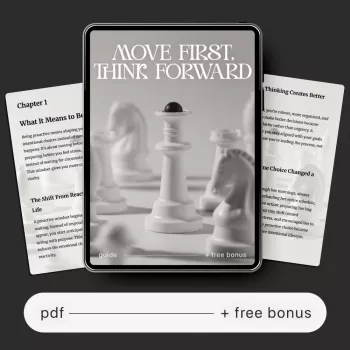
A proactive mindset is less about constant motivation and more about having a simple system for taking the next right step—especially when conditions aren’t perfect. “Move First, Think Forward” is a printable, digital self-improvement guide designed to help turn overthinking into action through small, repeatable check-ins that support planning, follow-through, and reflection.
What a proactive mindset looks like in everyday life
Proactivity isn’t loud or dramatic. It shows up in tiny, repeatable choices that keep life moving—even when you’re busy, tired, or unsure.
- Taking a small action before waiting for total clarity: sending the first email, opening the document, doing a 5-minute tidy.
- Choosing controllable inputs over uncontrollable outcomes: time blocks, routines, and environments instead of fixating on praise, perfect results, or timing.
- Deciding next steps using “if–then” plans: pre-deciding how you’ll respond to common friction points rather than negotiating with yourself in the moment.
- Recovering quickly after setbacks: focusing on the next actionable move instead of replaying what went wrong.
- Creating feedback loops: act → review → adjust → act again, so progress continues without needing a “fresh start.”
Why “move first” reduces overthinking
Overthinking often feels like preparation, but it can become a loop that delays action. “Move first” breaks the loop by replacing abstract worry with concrete information.
- Action generates information: a small experiment can answer questions that rumination can’t.
- Starting lowers resistance: the first 2–5 minutes are usually the hardest part.
- Momentum builds confidence: repeated follow-through strengthens self-trust.
- Structure prevents spirals: a short, guided page keeps thinking focused and finite.
- Pre-made decisions reduce effort: defining what/when/where ahead of time makes follow-through more automatic.
Research on implementation intentions (“if–then” planning) supports this approach by showing that specific plans increase the likelihood of following through on goals. See: Implementation Intentions and Goal Achievement (American Psychologist) and an overview on PubMed.
What’s inside the printable self-improvement guide (digital download)
The Move First, Think Forward printable self-improvement guide is built for real-life weeks—when motivation is inconsistent and time is limited.
- Action-first pages to clarify the next step when motivation is low.
- Reflection pages that focus on learning (not self-criticism).
- Simple planning layouts that translate goals into weekly and daily actions.
- Space for triggers, obstacles, and response plans so you’re prepared for the most common derailments.
- A repeatable framework that can be reused for work, health, learning, and personal projects.
A practical weekly routine using the pages
Consistency comes from keeping the routine small enough to repeat. The goal isn’t to plan perfectly—it’s to keep deciding the next move.
- Weekly reset (10–15 minutes): choose 1–3 priorities and define what “done” looks like in observable terms.
- Daily start (3–5 minutes): pick the smallest next action that moves one priority forward.
- Midday check-in (2 minutes): notice what’s stuck and reduce the task until it’s doable.
- End-of-day review (5 minutes): record what worked, what didn’t, and the next action for tomorrow.
- End-of-week reflection (10 minutes): identify patterns (energy, environment, timing) and adjust the plan.
Weekly setup: turn intentions into next actions
| Step | Prompt | Example output |
|---|---|---|
| Pick a focus | What matters most this week? | Submit project outline |
| Define success | How will progress be visible? | Outline + 3 key sources selected |
| Shrink the first step | What is the easiest start? | Open doc and write 5 bullets |
| Add an if–then plan | If X happens, then what? | If tired after work, then do 10 minutes only |
| Schedule it | When and where will it happen? | Tue 7:30–7:45 at desk |
Common sticking points—and how to respond proactively
Proactive people don’t have fewer obstacles; they have better default responses. A few simple rules can keep progress intact.
- Perfectionism: use a “version 1” rule (draft first, polish later) and define a minimum viable result.
- Low energy: switch to a low-friction task (prep, outline, gather materials) rather than quitting entirely.
- Too many goals: cap active priorities to 1–3 and park the rest in a “later” list.
- Unclear next step: ask, “What would make this 10% easier?” and do that first.
- Inconsistent follow-through: anchor the task to an existing routine (after coffee, after shower, after commute).
In work settings, proactive behavior is also linked to better performance and adaptability—especially when the environment changes quickly. For additional context, see Harvard Business Review.
How to print and use it in a way that actually gets used
Pairing proactive planning with better rest for more follow-through
For an easy sleep-support companion, consider the AI-powered checklist for better sleep adventures to help streamline your evening routine and improve recovery.
Helpful add-ons for action-friendly routines
Sometimes follow-through improves when your environment supports movement—especially for goals tied to health, walking breaks, or quick workouts between tasks. If you’re building a simple routine that includes exercise, a comfortable basic can remove one more barrier: Men’s quick-dry short sleeve sports shirt – lightweight workout & running top.
FAQ
Is this guide suitable for beginners who feel stuck or unmotivated?
Yes. It’s designed around small, low-friction steps that reduce overwhelm and create quick wins, so you can build momentum without waiting to “feel ready.”
What do you need to use the digital download?
A printer is optional. You can print the pages you want, or use the file on a tablet with an annotation app; you’ll just need a way to open the download and save it for reuse.
How quickly can results be noticed?
Many people notice small improvements within days when they use the pages consistently—like starting faster and getting unstuck sooner. Bigger mindset changes typically show up over weeks through measurable behaviors like more follow-through and fewer missed restarts.









Leave a comment