Gentle Growth: Self-Awareness, Boundaries, Real Confidence

Growth That Feels Right: A Gentle Path to Self-Awareness and Confidence
Meaningful growth doesn’t have to be fast to be real. When progress matches your values, your energy, and your actual capacity, it becomes easier to sustain—and easier to feel proud of. The goal isn’t a perfect routine; it’s a reliable relationship with yourself that supports small, confidence-building actions over time.
What “growth that feels right” looks like in daily life
Healthy growth often feels surprisingly ordinary. Instead of big breakthroughs that require constant willpower, it shows up as steady choices you can repeat—even in busy weeks.
- Progress feels steady rather than frantic, even when life is busy.
- Decisions are guided by values and needs, not pressure or comparison.
- Setbacks are treated as information, not proof of failure.
- Boundaries protect time, energy, and attention without constant guilt.
- Confidence is built through repeatable actions, not occasional motivation.
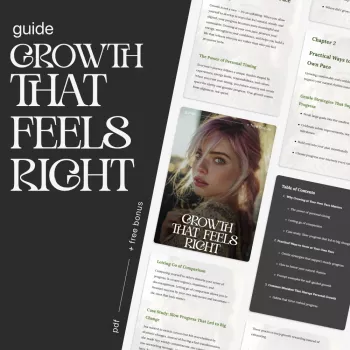
If you want a structured way to practice this week by week, Growth That Feels Right | Guide on How to Grow at Your Own Pace with Self-Awareness and Confidence is designed as a practical companion you can revisit—not a one-time read that you “fail” to keep up with.
Start with self-awareness: the three signals to track
Self-awareness doesn’t have to mean intense introspection. A simple approach is to track three signals that shape nearly every decision: energy, emotions, and attention. Over time, patterns become clearer than any single day.
1) Energy
Notice what restores you versus what drains you. This helps you choose realistic goals and prevents “motivation debt” (pushing so hard today that tomorrow collapses). Consider keeping a quick 1–10 energy rating in your notes at midday and evening.
2) Emotions
Look for repeat loops—avoidance, overcommitting, self-criticism—and what reliably triggers them. The point isn’t to judge the emotion, but to learn what it’s trying to protect you from. For broader mental health support practices, the National Institute of Mental Health offers practical guidance on caring for your mental health.
3) Attention
Track what consistently pulls your focus. Persistent distraction often reveals priorities (what you care about) or hidden stressors (what your nervous system is trying to manage). If your attention keeps snapping to unfinished tasks, social feeds, or worries, that’s data—not a character flaw.
Simple check-in prompts:
- “What feels heavy today?”
- “What feels doable?”
- “What matters most this week?”
A brief weekly review is usually more helpful than overanalyzing a tough day. For a resilience lens that supports this kind of steady, values-based approach, the American Psychological Association outlines core ideas around building resilience.
Set a pace you can keep: small goals with built-in flexibility
Consistency doesn’t require perfect conditions—it requires a plan that works when conditions are imperfect. The key is to build a “minimum version” of your goal that still counts on low-capacity days, then expand only when you genuinely have room.
- Choose a “minimum version” that still counts (and keep it small).
- Use time-based commitments (10–15 minutes) instead of outcome pressure (finish everything).
- Plan in seasons: some weeks are for building; others are for maintaining.
- Create friction reducers: lay out materials, set reminders, pre-decide a start time.
- Define what “enough” looks like to prevent moving goalposts.
Pace-Setting Options (choose one per goal)
| Approach | Best for | Example |
|---|---|---|
| Minimum baseline | Consistency when motivation dips | Write 3 sentences, not 3 pages |
| Time block | Reducing perfectionism | Practice for 15 minutes |
| Two-tier plan | Unpredictable schedules | Plan A: 30 minutes; Plan B: 5 minutes |
| Weekly focus | Avoiding overload | One priority + two maintenance tasks |
If better rest is part of your “capacity plan,” consider pairing your weekly rhythm with a simple sleep routine. AI-Powered Checklist for Better Sleep Adventures | Digital Sleep Guide for Relaxation, Lucid Dreaming & ai suggestions for better dreams can help you build repeatable nighttime cues, which often improves follow-through on daytime goals.
Build confidence through evidence, not hype
Confidence sticks when it’s based on proof: small actions completed again and again. Instead of waiting to “feel ready,” treat readiness as something you build through repetition.
For some people, a bit of movement supports confidence and mood—especially when it’s frictionless. Something as simple as having comfortable gear ready to go can reduce resistance. If that helps, Men’s Quick-Dry Short Sleeve Sports Shirt – Lightweight Workout & Running Top is a practical option for quick walks, workouts, or “minimum baseline” movement days.
A simple weekly rhythm: reflect, choose, act, recover
Sleep is one of the fastest ways to protect capacity. If you’re rebuilding your basics, the CDC’s overview of sleep and sleep disorders offers a helpful, research-backed starting point.
Common blockers—and gentle ways to move through them
Using the guide as a practical companion
FAQ
How can growth be real if it feels slow?
Slow growth is often the most sustainable because it compounds: small actions repeated become stable habits. For example, a minimum baseline like “five minutes of planning” can keep momentum alive on low-capacity days, making it easier to do more when life lightens up.
What if self-awareness makes uncomfortable feelings louder?
That can happen at first, especially if you’ve been pushing past feelings for a long time. Try shorter check-ins (1–2 minutes), focus on observing without judging, and choose one small actionable adjustment rather than trying to “fix everything” at once.
How do you know when to push yourself versus rest?
Use a simple rule: if pushing will create a bigger problem tomorrow (poor sleep, resentment, shutdown), rest is protective; if a small step will reduce stress later, push gently. Two-tier plans help—do Plan A when energy is steady, and Plan B when energy is low without abandoning the goal.









Leave a comment