Quiet Your Inner Critic: 3 Steps to Kinder Self-Talk

Dismantling Your Inner Critic: A Friendly Path from Harsh Self-Talk to Self-Trust
An inner critic can sound like “helpful realism,” but it often fuels anxiety, procrastination, and a constant sense of not being enough. The good news: the inner critic is a learned pattern—not a life sentence. With a few practical tools, it becomes possible to recognize the critic’s voice, reduce its volume, and replace it with a steadier, kinder inner coach.
What the Inner Critic Really Is (and Why It Feels So Convincing)
The inner critic is often a protective strategy learned early. At some point, being hard on yourself may have felt like the best way to prevent failure, avoid rejection, or stay “good enough” to be safe. The problem is that the strategy can keep running long after it stops helping.
That’s why the critic tends to speak in absolutes (“always,” “never”), sticky labels (“lazy,” “messy”), and ominous predictions (“this will go badly”). Those statements can feel urgent because self-criticism is linked to the body’s threat response—heart rate rises, muscles tense, and the mind narrows as if danger is present.
The goal isn’t to delete the critic overnight. The goal is to change the relationship with it: less obedience, more discernment. You can learn to hear the critic without treating it like a command.
For a deeper look at how self-compassion supports resilience and healthier motivation, the American Psychological Association offers a helpful overview here: American Psychological Association — Self-compassion.
Spot the Pattern: Common Inner-Critic Roles
Many people find it easier to work with the inner critic when it’s “typed” into roles. Naming a role creates a little space between you and the thought—enough space to choose a wiser response.
- The Perfectionist: sets impossible standards, then punishes normal human limits.
- The Taskmaster: uses pressure and shame as motivation; productivity becomes tied to self-worth.
- The Mind Reader: assumes others are judging, disappointed, or annoyed without evidence.
- The Historian: replays past mistakes as proof that growth isn’t real.
Try a quick label in real time: “That’s the Perfectionist talking,” or “Hello, Mind Reader.” It may feel corny at first, but it reliably reduces how fused you feel with the thought.
Inner-critic scripts and friendly replacements
| Critic says | What it’s trying to protect | A steadier inner-coach response |
|---|---|---|
| “If it’s not perfect, it’s embarrassing.” | Avoiding judgment or rejection | “Good enough can still be effective. Progress first, polish later.” |
| “You’re behind. You’re failing.” | Preventing loss of control | “Let’s pick the next right step. One action beats panic.” |
| “Everyone noticed you messed up.” | Staying safe socially | “Some people may not care; if they do, it’s manageable. Learn and move on.” |
| “You always do this.” | Predictability and certainty | “This is a familiar pattern, not a fixed identity. Change is possible.” |
A 3-Step Reset for the Moment the Critic Shows Up
When the inner critic hits, it’s tempting to argue with it—or to surrender to it. A middle path works better: acknowledge what’s happening, regulate the stress response, then choose a more supportive inner voice.
Step 1: Notice and label
Use a simple cue: “Inner critic is here.” Labeling reduces emotional intensity and turns a swirl of self-judgment into something observable.
Step 2: Validate the emotion without endorsing the message
Validation isn’t agreement; it’s honesty. Example: “This is hard, and I’m feeling exposed.” This keeps you from turning pain into a second layer of shame.
Step 3: Choose a compassionate reframe that stays honest
Optional 30-second body reset
Transform Negative Self-Talk Without Pretending Everything Is Fine
If harsh thoughts are tangled with anxiety patterns, it can help to learn more about how anxiety works and when to seek support: National Institute of Mental Health — Anxiety Disorders.
Build an Inner Coach: A Simple Practice for Emotional Growth
For those who like structured tools, CBT-style approaches are commonly used to challenge unhelpful thinking patterns. A plain-language overview is available here: NHS — Cognitive behavioural therapy (CBT).
A Friendly Tool You Can Keep: Digital eBook for Practicing These Skills
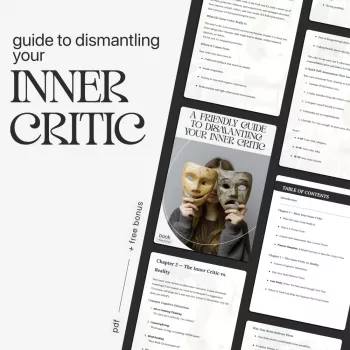
If you want a structured companion for this work, consider A Friendly Guide to Dismantling Your Inner Critic (Digital eBook), designed for ongoing emotional growth and learning how to stop the inner critic from running the day.
Sleep can also amplify self-criticism when it’s disrupted. For a gentle, practical add-on to support rest (and reduce next-day reactivity), pair your routine with AI-Powered Checklist for Better Sleep Adventures (Digital Sleep Guide).
Quick start routine (weekly)
| Day | Focus | Time | Outcome |
|---|---|---|---|
| Mon | Identify critic role + triggers | 10 min | More awareness, less autopilot |
| Wed | Reframe 3 recurring scripts | 15 min | Kinder, more accurate self-talk |
| Fri | Small action plan + celebration | 10 min | Momentum and self-trust |
When the Inner Critic Signals Something Deeper
FAQ
Why is my inner critic so loud even when things are going well?
For some people, calm moments trigger vigilance: the mind scans for what could go wrong so success doesn’t get “taken away.” Label the critic, ground in the present, and practice inner-coach language during low-stress times so it’s easier to access when pressure hits.
How can I stop negative self-talk if it feels automatic?
Use a repeatable sequence: notice and label the critic, validate the feeling underneath, reframe to a believable statement, then choose one small action. Over time, tracking triggers and practicing the reset builds a new default response.
Is it possible to get rid of the inner critic completely?
Many people don’t eliminate it entirely, but they do reduce its intensity and influence. The practical goal is less control from the critic and more leadership from your values and inner coach—plus professional support if the thoughts are severe or persistent.









Leave a comment