AI Study Checklist: Plan, Practice, Review With ChatGPT
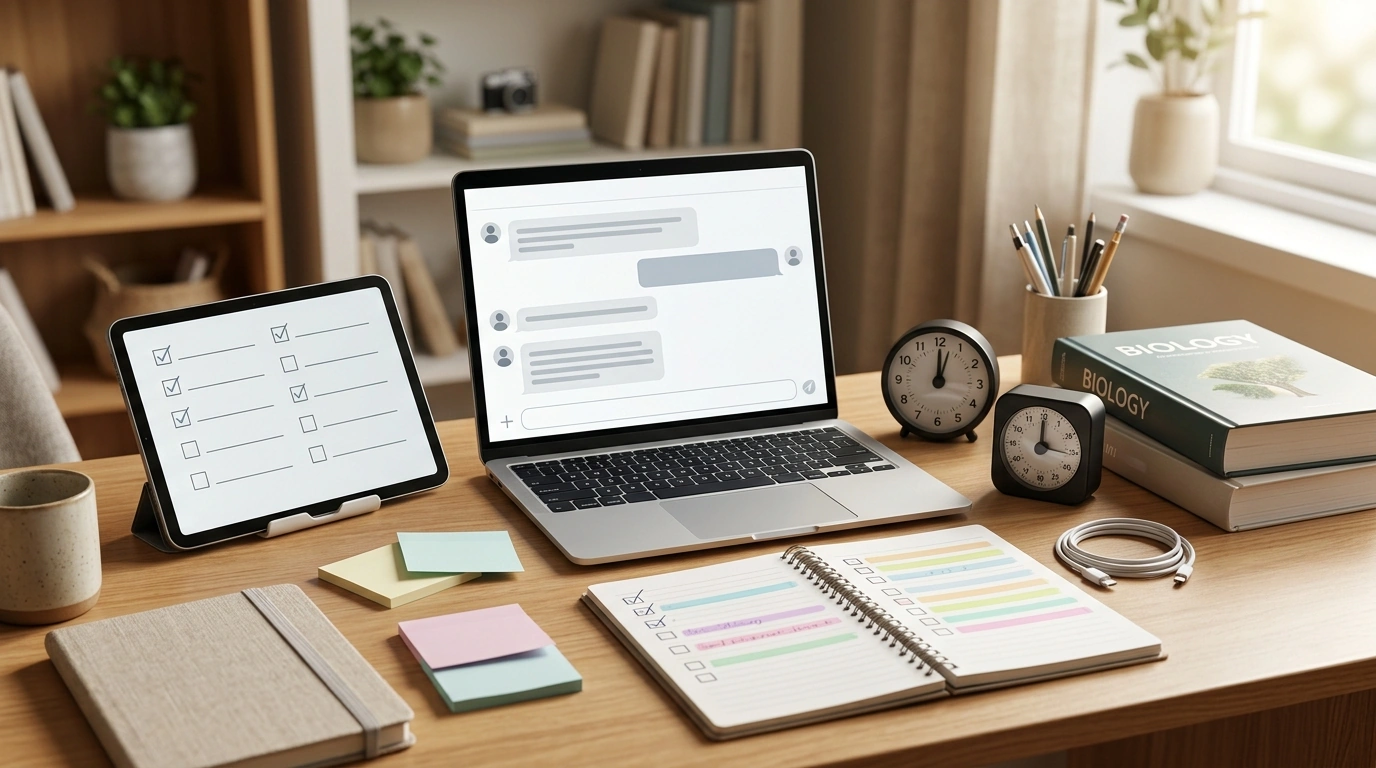
AI-Powered Study Hacks Checklist: A Simple System to Plan, Practice, and Review
A checklist-based study system gets results when it reduces decision fatigue and keeps practice consistent. Add AI to the mix and it becomes easier to break big assignments into smaller steps, generate practice questions, summarize readings, and spot gaps—without losing track of what to do next. Below is a practical, student-friendly workflow using an AI-powered study checklist (printable or digital) for daily planning, focused sessions, and smarter review.
What makes an AI-powered checklist different from a regular study plan
A normal study plan often stays high-level (“study biology”) and relies on motivation to fill in the details. An AI-powered checklist turns that into repeatable actions you can complete even on low-energy days.
- It converts vague tasks into concrete moves like “write 10 retrieval questions,” “do a 15-minute error-log review,” or “make a teach-back summary.”
- AI adds speed (drafting outlines, generating practice sets, simplifying explanations), while the checklist adds quality control (verify, correct, and practice).
- It reinforces a loop you can run daily: plan → focus → self-test → reflect → adjust.
- It creates a record of learning: what you studied, what you missed, and what needs spaced repetition.
The biggest advantage is that the checklist keeps you doing the activities that actually drive long-term learning—especially retrieval practice and spaced review. Research has shown retrieval practice can outperform many “study harder” strategies because it forces the brain to reconstruct information instead of re-reading it passively (Science).
Set up the system in 10 minutes
Keep setup lightweight so you can start today and refine later. The goal is one reliable place to plan and one reliable place to store AI outputs (summaries, quizzes, explanations).
- Choose format: print the checklist for a desk setup or use a digital copy for tablet/laptop annotation.
- Create three lists: (1) deadlines and exams, (2) weekly targets by subject, (3) today’s top 3 outcomes.
- Pick a single place to store AI outputs: one folder or note per course (summaries, practice questions, study guides).
- Decide on a session structure: 25/5 or 50/10 focus blocks, plus a short review block at the end.
Quick setup checklist
| Step | What to decide | Default option |
|---|---|---|
| Format | Printable or digital | Digital during the week, printable for exam weeks |
| Planning horizon | Daily + weekly overview | 10 minutes daily, 30 minutes weekly |
| AI workspace | Where drafts and practice sets live | One note per course + dated subpages |
| Study blocks | How long to focus before a break | 25/5 for reading-heavy, 50/10 for problem sets |
Daily workflow: plan → learn → test → refine
This workflow is designed to be “same shape, different subject” so you don’t reinvent your approach every day.
- Plan (5–10 min): Pick one primary task per class and estimate how many focus blocks it will take. Write a finish line (example: “Complete 20 practice questions and log misses”).
- Learn (1–3 blocks): Read, watch, or review. Use AI to simplify a dense passage or turn a lecture chunk into a structured outline you can navigate quickly.
- Test (1 block): Do retrieval practice—answer without notes. If you run out of questions, have AI generate more at the same style and difficulty as your exam.
- Refine (5–10 min): Update an error log (what went wrong, why, and the correct method), then schedule a quick revisit in 2–3 days for spaced repetition.
Spacing matters because memory improves when you revisit material over time rather than cramming it in one sitting (APA overview of the spacing effect).
AI tasks that pair well with a study checklist
AI works best when it produces something you can act on immediately—then the checklist ensures you don’t stop at “generated.”
| Study task | AI can produce | Checklist follow-up |
|---|---|---|
| Reading a chapter | Section-by-section outline + key terms | Mark confusing sections and re-read only those |
| Preparing for a quiz | 15–25 retrieval questions | Track misses and redo in 48 hours |
| Problem sets | Worked-example templates | Do 3 problems without help before checking |
| Writing an essay | Argument map + counterarguments | Confirm sources and align with rubric |
| Exam review | Condensed “must-know” sheet | Use it to self-test, not to re-read passively |
Prompts that encourage learning (not copy-paste)
Accuracy and academic integrity guardrails
Printable vs digital: choosing what fits your routine
If you want a ready-to-use template that supports both formats, the AI-Powered Study Hacks checklist (printable + digital) is designed around plan/practice/review blocks, including space for error logs and spaced revisits.
Common sticking points and quick fixes
Tools to support the checklist routine
Use your checklist as the backbone, then add a recovery layer so your brain can actually consolidate what you practiced. Sleep supports attention and memory consolidation, which directly affects test performance (National Institutes of Health).
- AI-Powered Study Hacks | Printable & Digital Checklist for Students (daily plan, focus blocks, retrieval practice, and review tracking)
- AI-Powered Checklist for Better Sleep Adventures (a simple wind-down routine to protect recovery during busy weeks)
FAQ
Can AI actually help improve studying without making learning passive?
Yes—when it’s used for retrieval practice, explanations, and feedback loops. Prioritize self-testing, keep an error log, and verify key facts with course materials rather than only re-reading AI summaries.
What’s the best way to use AI to study for exams?
Use it to generate exam-style questions, run timed mini-quizzes, and analyze wrong answers to find patterns. Then schedule spaced reviews so the same weak points get revisited before test day.
Printable or digital: which study checklist works better?
Printable is usually best for visibility and habit formation, while digital is best for linking notes and storing AI outputs. Many students do best with a hybrid setup: digital planning and materials, printed execution.







Leave a comment